
Angel Sanchez Güeche
Jun 16, 2026
Table of Contents
- Introduction
- What is the difference between web design and development?
- Web design focuses on experience, clarity, and conversion
- Web development focuses on function, performance, and scale
- Why businesses often confuse the two
- The difference between web design and development in real projects
- Which matters more?
- What to ask before hiring a web partner
- A better way to think about your website
Introduction
A lot of businesses realise they need a better website only when something starts breaking down. Leads drop off. Updating pages is a pain. The site looks decent enough, but it is slow, hard to manage, or disconnected from the way the business actually works. That is usually when the difference between web design and development stops being a technical detail and becomes a commercial one.
If you are hiring a partner, setting a budget, or trying to understand why one website performs and another does not, this distinction matters. Design and development are closely linked, but they do different jobs. Treating them as the same thing is one of the main reasons businesses end up with websites that look polished yet underperform.
What is the difference between web design and development?
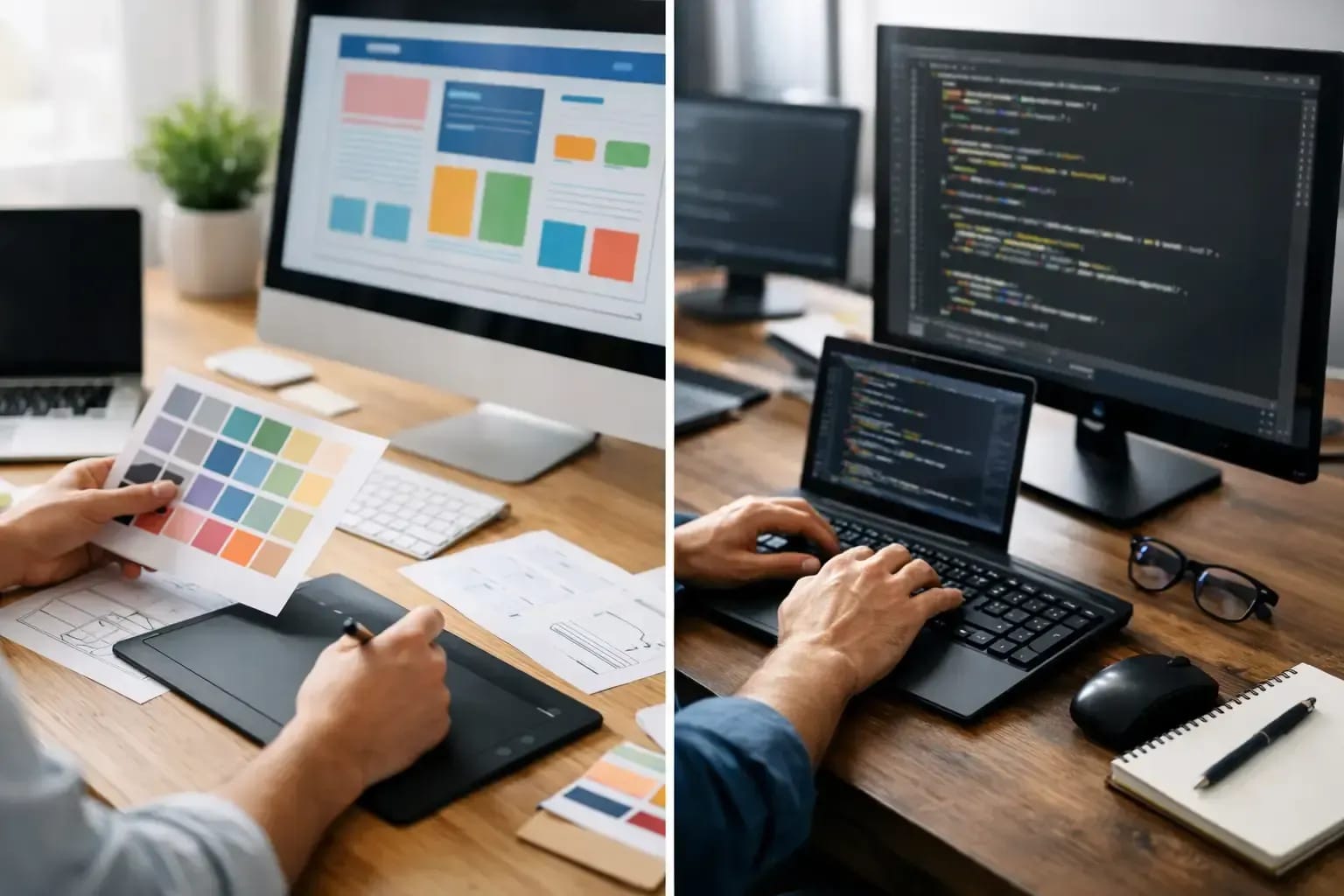
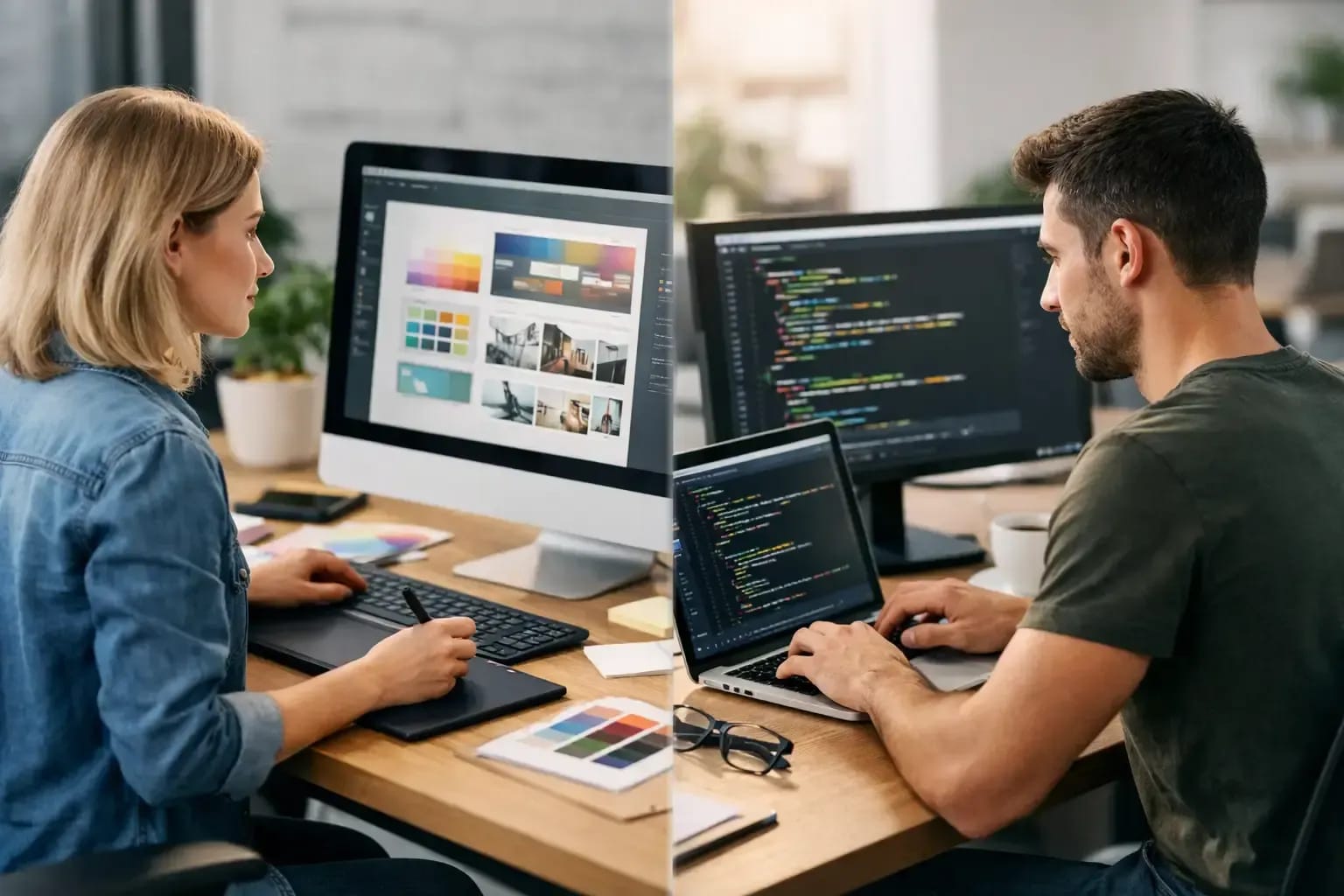
Web design is about how a website looks, feels, and guides a user. It covers layout, visual hierarchy, branding, user experience, interface decisions, and the way information is structured on the page. A designer decides what a visitor sees, what they notice first, and how easy it is to take the next step.
Web development is about building the thing properly. It turns approved designs into a working website using code, platforms, frameworks, databases, integrations, and technical logic. A developer makes sure buttons work, forms submit correctly, pages load efficiently, content can be managed, and the site functions reliably across devices and browsers.
A simple way to think about it is this: design shapes the experience, development delivers the functionality.
That said, the boundary is not always clean. Good designers understand technical constraints. Good developers care about usability and layout. On smaller projects, one person may handle both. On more serious business websites, they are usually separate disciplines that need to work in step.
Web design focuses on experience, clarity, and conversion
The design side of a website is not decoration. Done well, it helps a business communicate value quickly and move users towards action.
That starts with structure. Before colours, typography, or imagery, design deals with what goes where. Which messages belong on the homepage? What should a service page prioritise? How should the navigation be organised so visitors do not get lost? These are business decisions as much as creative ones.
Then there is user interface design. This is where the visual system comes in - spacing, buttons, forms, menus, page layouts, and the overall consistency of the site. Strong interface design reduces friction. Weak interface design creates hesitation, confusion, or mistrust.
User experience matters here too. A good designer thinks about how different visitors behave. A first-time visitor needs clarity and reassurance. A returning user may want quick access to a specific page. A mobile user has less screen space and less patience. Design should reflect those realities, not just brand preferences.
For growth-minded businesses, the real test of web design is whether it supports outcomes. Does the site make the offer clear? Does it help users understand the next step? Does it build confidence? A website can be visually strong and still fail if it does not support sales, lead generation, recruitment, or customer service.
Web development focuses on function, performance, and scale
If design is the front-facing experience, development is the system underneath it. This is where websites either hold up under real use or quietly create problems.
Development includes front-end work, which is the code that controls what users see and interact with in the browser. It also includes back-end work, which handles server-side logic, databases, user accounts, content management, integrations, and application behaviour.
For a business website, development decisions affect far more than speed. They influence security, reliability, scalability, maintainability, and operational usefulness. If your team needs to update content regularly, the site must have a sensible content management setup. If leads need to flow into a CRM, that integration has to be built properly. If the business plans to add landing pages, multilingual content, booking functionality, or automation later, the technical foundation should support that.
This is where many projects go wrong. A site may be built to match the design perfectly, but with poor development underneath. The result is a fragile asset that is hard to update, expensive to extend, and full of workarounds. That problem often stays hidden until the business tries to grow.
Why businesses often confuse the two
The confusion usually comes from the fact that clients experience a website as one thing. They see pages, branding, copy, buttons, forms, and movement all together. Naturally, they ask for a new website rather than separating the design challenge from the development challenge.
The market adds to this. Plenty of providers sell "web design" as a catch-all term, even when they are really offering template setup, light development, or basic page building. Others focus heavily on visuals while treating technical implementation as a secondary task. That can make the buying process murky, especially for non-technical founders or teams.
There is also a practical overlap. Some designers work in tools that let them create near-functional prototypes. Some developers use page builders and low-code platforms with a strong visual layer. Modern workflows blur the edges, but that does not remove the difference in skill set or responsibility.
The difference between web design and development in real projects
On a real project, design usually answers questions like: what should this page communicate, how should the user move through the site, and what should the experience feel like?
Development answers different questions: how will this be built, what system should it run on, how will content be managed, what needs to integrate with other tools, and how do we make this reliable long term?
Take a service-based business redesign. The design work may involve restructuring the sitemap, clarifying service pages, improving mobile layouts, and creating stronger calls to action. The development work may involve building a flexible CMS, integrating enquiry forms with internal workflows, improving page speed, and setting up tracking so marketing performance can actually be measured.
Both matter. If the design is poor, users do not engage. If the development is poor, the business cannot operate efficiently or scale the site without friction.
Which matters more?
It depends on the current problem.
If your site feels dated, confuses users, or fails to explain what you do, design is probably the bigger issue. If your site is difficult to edit, technically outdated, slow, or disconnected from business systems, development is likely the stronger priority.
In practice, most established businesses need both. A website is not just a brochure. It is part of the operating infrastructure. It supports brand perception, lead generation, sales conversations, reporting, and internal workflows. That means the right question is rarely design or development. It is whether both are being handled with enough strategic thinking.
This is especially true for growing companies. A site that works for a small team with a simple offer may not suit a business adding new services, locations, team members, campaigns, or automation. What looked fine at launch can become restrictive very quickly if the technical setup was too shallow or the design did not account for future needs.
What to ask before hiring a web partner
If you are briefing a studio or freelancer, ask how they approach both sides of the work. Not just how the site will look, but how it will function, how content will be managed, what happens after launch, and how the build supports marketing, operations, and future changes.
You should also ask who is doing what. Is the designer also the developer? Is development outsourced? Are technical decisions being made early, or only after visuals are approved? None of these setups are automatically wrong, but they do affect quality and accountability.
The strongest projects are usually the ones where design and development are not treated as separate handovers, but as coordinated disciplines tied to business goals. That means fewer compromises, fewer rebuilds, and fewer awkward moments where a visually appealing idea turns out to be impractical.
For that reason, agencies such as Map to Moon tend to approach websites as business systems rather than isolated creative projects. The visual layer matters, but so do the structure, integrations, content workflows, and long-term usefulness of the platform.
A better way to think about your website
The difference between web design and development is not just about who does which task. It is about understanding that a good website has two jobs at once. It has to create confidence for the user and function properly for the business.
When those two sides are aligned, your website becomes more than a nice-looking asset. It becomes something your team can use, improve, and build on. That is usually where better performance starts - not with trend-led redesigns, but with a clearer view of what the site needs to do.